Peter Wennink at the UvA: AI innovation calls for broad talent and collaboration
14 September 2026
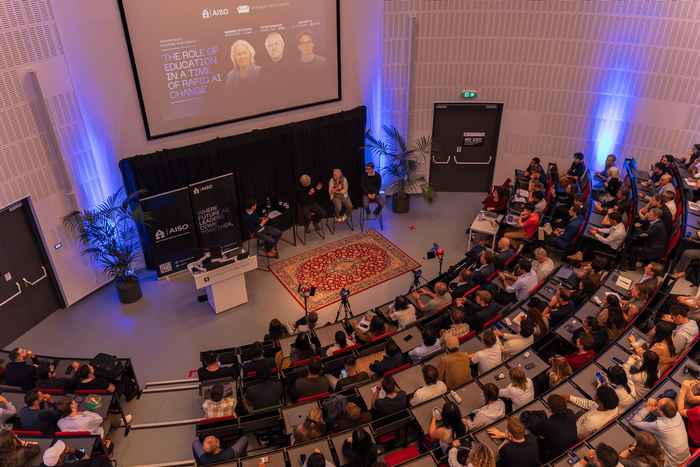
Wennink came at the invitation of AI student association AISO, at the start of the academic year. AISO aims not only to prepare students better for a future with AI, but also to involve them actively in the debate on AI and talent development. In his advisory report, Wennink identifies digitalisation and AI as a domain in which the Netherlands needs to innovate. To date, the debate on AI innovation has centred largely on investment and policy, and rather little on talent. It was precisely that question of talent that took centre stage in two panel discussions.
'Without the social sciences, ASML would not exist'
At ASML, Wennink saw how important it is to have teams in which people with different competencies work together on a complex problem. Those competencies extend well beyond technology: without knowledge from the social sciences, he believes, the company would never have got off the ground. He did, however, point to a shortage of STEM talent, which the Netherlands needs to address in the short term.
In a session for educational professionals, Wennink spoke with Rector Magnificus Anniek de Ruijter and deans Roel Beetsma (Faculty of Economics and Business) and Christa Boer (Faculty of Social and Behavioural Sciences). The AI transformation is complex and hard to predict, and it is moving extremely fast, the panel argued. That calls for forms of organisation that make collaboration across disciplines and faculties possible. In this, the panellists see an important role for the social sciences, economics, business and law — both in AI innovation itself and in applying the technology in everyday life and in the labour market.
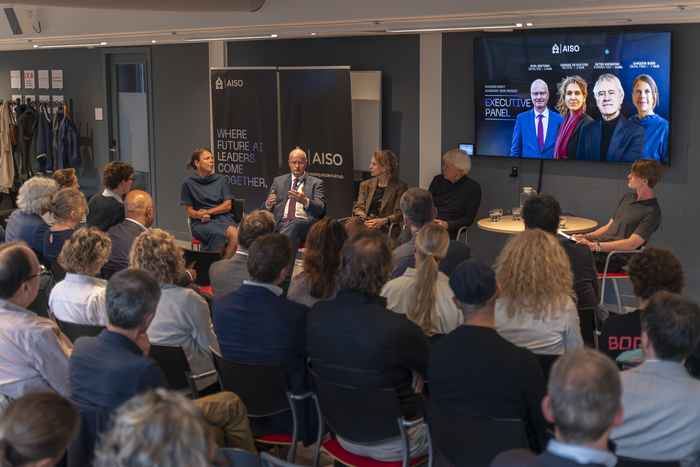
The panel also made the case for collaboration beyond the university, with the business community for instance. Beetsma: 'That is why, at Economics and Business, we are committed to teaching built around real questions from practice. In the AI4Business Lab, student teams develop AI solutions for companies.'
'The bigger the problem, the bigger the innovation'
Some 450 visitors, students for the most part, attended the public panel hosted by AISO and Room for Discussion, the interview platform run by UvA students. Their critical outlook came through in the questions from the floor: several students voiced concerns about the negative social consequences of AI. Wennink acknowledged those consequences, but remained optimistic. Those who respond quickly will find solutions, he argued, and big problems give rise to big innovations.
Joining Wennink on the panel were Annebel de Hoogh, Professor of Leadership and Management, and AISO co-founder Jan Pecka. Pecka questioned whether students can still trust the university to teach them the competencies they will need in the years ahead. He argued for a more flexible curriculum and closer collaboration with the business community. De Hoogh offered a more nuanced view: technology is developing so rapidly that it would not be desirable to keep revising the curriculum.
Wennink and De Hoogh both cited AISO itself as an example. The curriculum should reward students who seek out collaboration, dare to take risks and innovate, Wennink said. AISO, for instance, organises hackathons with tech companies, in which teams devise solutions to a concrete problem in a short space of time. Universities should make room for such initiatives, De Hoogh emphasised.
Employers, too, face considerable uncertainty as a result of the AI transformation, Wennink said. They need people who can keep pace with rapid developments and make sense of their implications. It is precisely that curiosity and critical outlook, in his view, that are important qualities of universities and their students.