Festive farewell ceremony for professor Peter van Baalen
4 March 2026
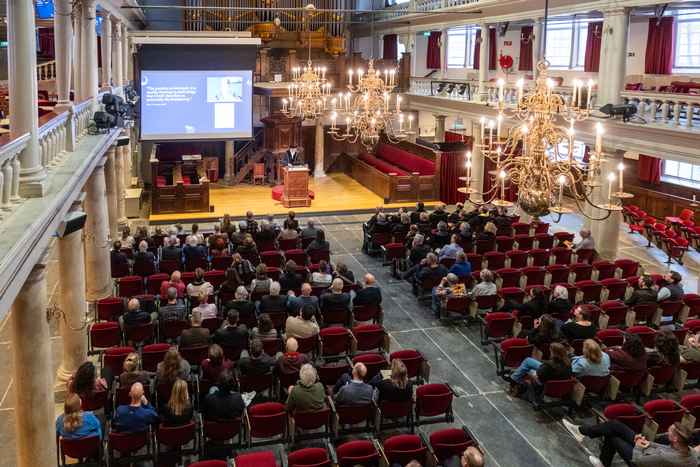
As a special tribute, Van Baalen was appointed Officer in the Order of Orange-Nassau. During an informal gathering at De Brug, former colleagues reflected more extensively on his impressive academic career.
Van Baalen joined UvA Economics and Business (UvA EB) more than 12 years ago as professor and director of the College of Economics and Business. In that role, he was responsible for the Bachelor's programmes in Economics and Business. Prior to that, he was associate professor at the Rotterdam School of Management (RSM), where he also obtained his PhD.
Contribution to UvA EB, the UvA and the academic world
In his welcome speech, UvA EB dean Roel Beetsma emphasised the significant impact Van Baalen has had on the faculty, the university and the wider academic community. Under his leadership, the number of students doubled and teaching was professionalised. His substantive expertise in the field of education and research, combined with his decisive governance made his achievements visible both within and outside the university.
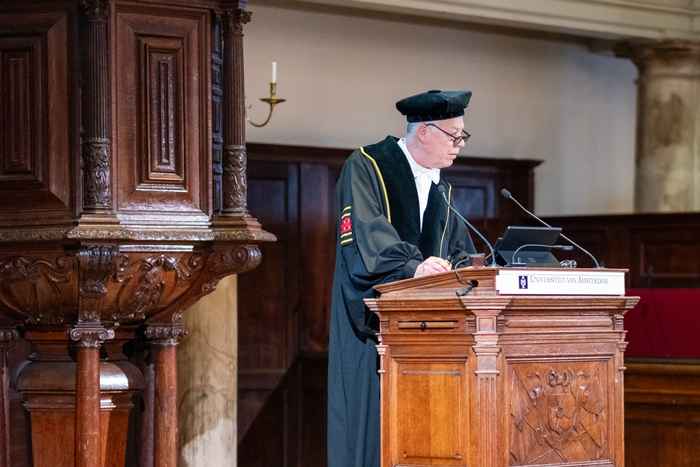
From digital discomfort to taking control of AI in higher education
In his farewell speech, Van Baalen outlined how GenAI has shaken up higher education in a short period of time. According to him, AI is not magic, but a normal technology. The future of AI is not fixed, but is created by what people do with it. He places GenAI in a recognisable series of digital innovations. Its use is similar to how we previously started using calculators, smartphones and navigation systems to outsource thinking.
At the same time, he warned for what he calls a structural 'epistemic' deficit: GenAI predicts answers based on patterns in data, but sometimes confuses facts and plausible nonsense. The time savings that AI delivers can therefore be partially lost to checking and correction. Van Baalen further explored the influence of AI on learning. Cognitive outsourcing involves letting others do your thinking for you, which means you learn less deeply. Cognitive surrender involves blindly accepting output. He therefore advocated for the conscious design of cognitive frictions ('desirable difficulties'), as effort and doubt are part of learning.
According to Van Baalen, digital unease is not a problem that needs to be swept under the carpet, but rather a compass. By understanding technology and remaining critical, we can maintain control. GenAI is a passing wave and new waves will follow. The ongoing task is to continually transform discomfort into thoughtful design.
Token of appreciation
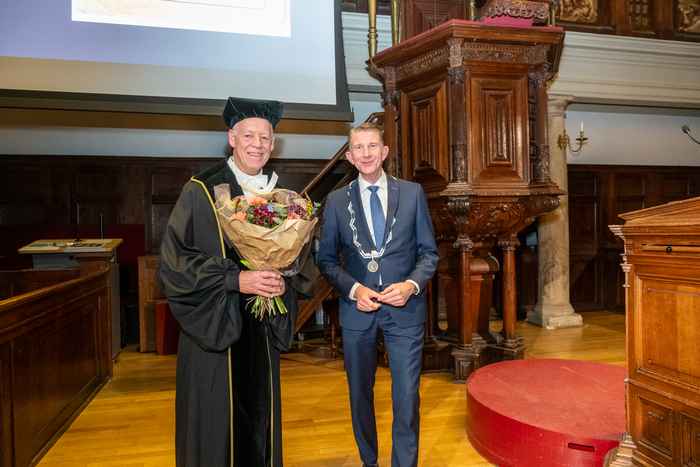
After the farewell lecture, the Mayor of Maassluis, Jack de Vries, took the floor. In 2014, Van Baalen was appointed Member of the Order of Orange-Nassau for his many years of service as a municipal councillor in Maassluis. According to De Vries, Van Baalen has not only made an exceptional contribution to society in terms of governance, but has also been committed to strengthening, internationalising and innovating Dutch academic education. De Vries emphasised that thanks to Van Baalen's efforts, the programmes at UvA EB have been strengthened and made more accessible to a wider audience. In doing so, he has brought science closer to society. In recognition of his exceptional services to higher education, Van Baalen was promoted to Officer in the Order of Orange-Nassau.
Farewell at De Brug
At the informal farewell drinks at De Brug, dean Beetsma gave an overview of the many improvements Van Baalen has worked on, such as the division of the Bachelor's programmes, the introduction of new programmes, and the implementation of blended learning and active learning. During the COVID-19 pandemic, Van Baalen made enormous strides in the development of online learning and examination. Former dean Han van Dissel discussed, among other things, Van Baalen's transition from RSM to the University of Amsterdam. Finally, a former colleague and professor at RSM provided a historical perspective on Van Baalen's early years. In Rotterdam, he was seen as the thinker, a role that was particularly appreciated in a culture that was mainly characterised by doers. Van Baalen had the last word and thanked everyone, from the board to the support staff, for the pleasant cooperation and the great achievements we have realised together. All in all, it was a festive farewell to Van Baalen, who has meant so much to UvA EB and the academic community.