Roshan Mahes, mathematical whizz, sinks his teeth into appointment scheduling
Turning down a great opportunity to work for a trading company and moving straight on to a PhD, while at the same time doing mathematical research for PostNL as well as participating in a prestigious Amazon challenge: it may sound ambitious, but Roshan Mahes thinks nothing of it.
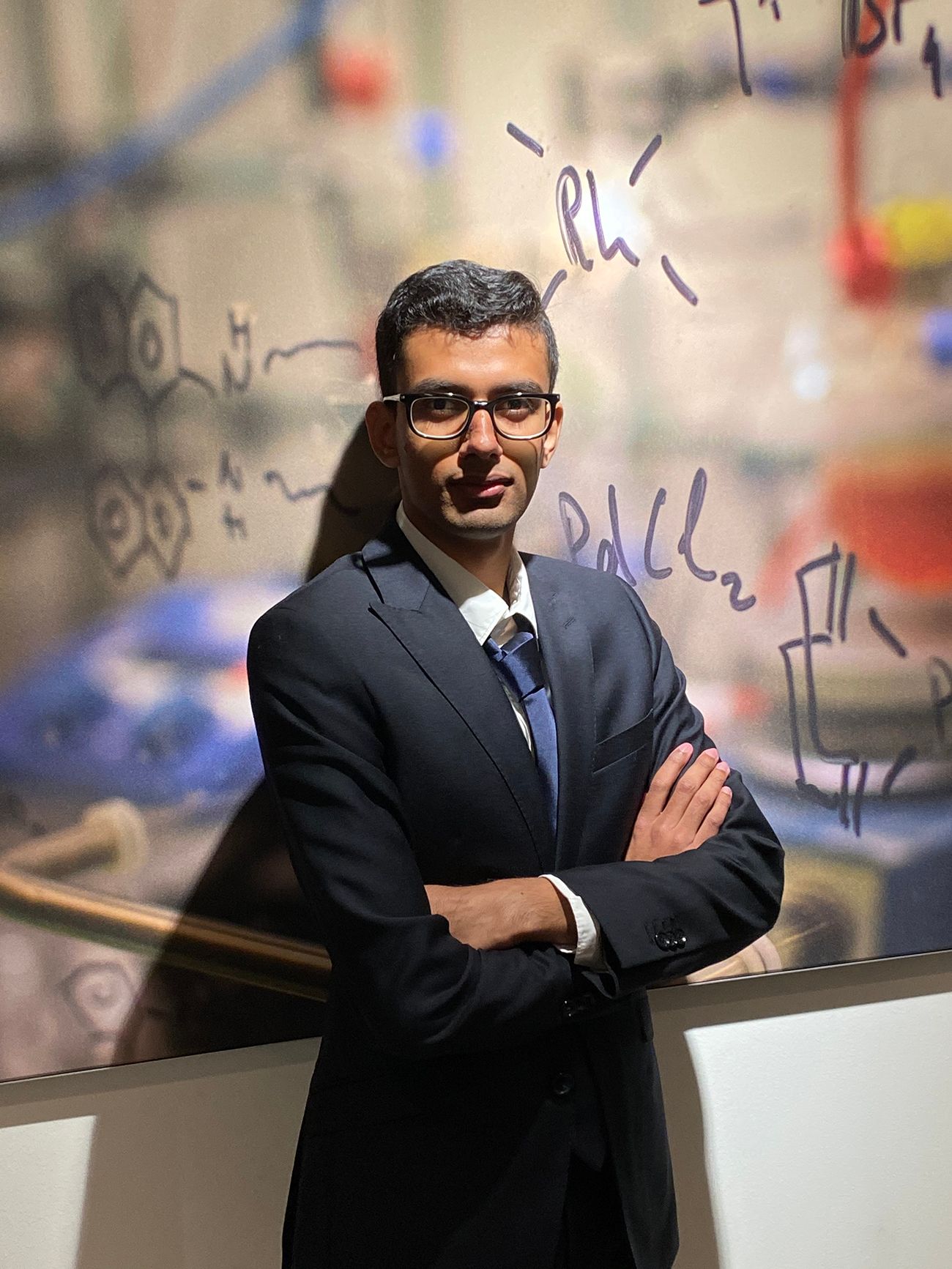
For Mahes, it all began with a bachelor’s degree in mathematics at the University of Amsterdam (UvA) back in 2015. 'The most logical next step was a master’s in mathematics and, in February 2020, I started my master’s dissertation on appointment scheduling,' Mahes explains as he summarises his first few years at UvA. As a result of the lockdown, Mahes wrote most of his dissertation away from campus but it did not affect the relevance or quality of his research. What’s more, during this period, his supervisor Michel Mandjes, a professor in the Faculty of Science, asked him if he might be interested in a PhD after his master’s.
At the same time, he was talking to an international trading company, which saw Mahes as an excellent potential asset. In the end, he went for a PhD. 'I felt I wasn’t quite finished with mathematics and wanted to do some more research.' He specifically meant research into appointment scheduling.
2-pronged approach to optimisation
Appointment scheduling requires optimisation on 2 fronts, Mahes points out. His master’s dissertation focusses primarily on appointments in health care. He goes on to describe the two sides of the spectrum: 'When a doctor’s diary is full, you don’t want him or her to be without patients in the surgery because that would mean time is being wasted. On the other hand, you don’t want a waiting room full of patients.'
'My dissertation was mostly about giving updates: if there are 3 people in the waiting room at 13:00 and you have an appointment at 13:15, then you know you’ll never get round to them on time.' Using the information you have at a specific moment and adjusting appointments: that, in a nutshell, is what Mahes’s dissertation was all about.
Joint research with PostNL
Prof. Marc Salomon, Dean of the Amsterdam Business School and Mahes’s main supervisor, agreed with Mahes and Mandjes that it was a very engaging and relevant research topic but, at the same time, he was convinced they should also get a business partner on board. 'And nowadays, where do you find an organisation with more appointments than PostNL? Hundreds of thousands of people are waiting for their parcels every day,' Mahes adds. With 2-hour time slots ('your parcel will be delivered between 13:00 and 15:00'), a very wide time span in this day and age, there is plenty of scope for optimisation.
The main challenge here is that people who deliver the post have full control over their own routes unlike people who deliver goods such as groceries. 'So it’s extremely difficult to estimate when the post will arrive. People who do this work are often very familiar with the neighbourhood and know, for instance, if there’s a school somewhere or that, for some reason, it’s very busy in a given street at a particular time or that there’s nobody home. These are all factors that influence their routes and hence the moment the post is delivered. But we feel certain that we can reduce the 2-hour time slot quite a bit without a significant loss in reliability.' The analysis would be based on historical information about delivery trips but not on specific drivers. 'This is not permitted under privacy regulations.' Mahes and Mandjes together with PostNL are now edging towards a well-thought-out new data model that extends PostNL’s existing model.
Amazon Challenge
The challenge Mahes and PostNL currently face bears considerable resemblance to a competition recently organised by web giant Amazon, featuring Mahes as a contestant along with 2 other PhD students at the ABS. 'On the basis of historical data such as travelling times, parcels, delivery addresses and other route information, we had to predict how a driver would deliver 300 parcels on a new day.'
A first attempt put Mahes and his fellow-contestants as high as 12th place out of a total of 229 submissions ‒ an impressive performance. 'Especially when you consider it was a fairly simple model. We’re now working to improve the model because the winner will get a publication in the journal Transportation Science about the use of machine learning in the determination of delivery routes.'
Apart from writing papers, doing collaborative research with PostNL and taking part in the Amazon Challenge, Mahes also lectures at the Amsterdam Business School. 'And, in November, I’ll be starting a module about deep learning as part of the artificial intelligence master’s course. This will help me learn more about the subject for my PostNL research.'